
The era of chasing single keyword(s) is gone.
Your content needs to be semantically relevant across a range of hidden fan out queries. A fancy way of saying you’ve got to cover a topic so well, it doesn’t matter how someone asks, the answer still leads to you.
The good folks at iPullRank, a content marketing and enterprise SEO agency, call this process “Relevance Engineering”. It’s the practice of making your content quantifiably findable, retrievable, and useful across all search and AI recommendation systems.
Sounds intense? That’s because it is.
It’s part math, science, and systems thinking. But we’re starting with the part anyone can get their hands on: content optimization. Or as they call it, content engineering.
- AI search relies on semantic relevance across multiple query variations.
- Users converse with AI. Their prompts carry richer, more specific intent than traditional keywords.
- AI systems use “query fan-outs” to generate synthetic queries. Your content must satisfy not just the main query, but its follow-ups and edge cases.
- Content structure is everything: short paragraphs, clear headings, and semantic triples improve retrievability.
- AI rewards multimodal content. Infuse your pages with visuals like videos, charts, and comparison tables to align with how AI parses and presents information.
- Technical SEO is necessary. Allow necessary AI bots (e.g., GPTBot, PerplexityBot), improve site speed, and serve clean HTML and schema markup.
- Schema isn’t always required, but still improves AI comprehension when paired with contextual clarity and smart formatting.
- Conversational prompt mining starts with users. Audit support logs, sales calls, and online communities to identify real-world phrasings and conversational patterns.
- Use Keyword.com to monitor brand mentions, AI share of voice, and zero-click impressions.
The Shift from SEO Keywords to AI Search Prompts
Traditional SEO taught us to target keywords as they were: specific, exact-match phrases users were typing into a search bar. But with AI search, that static input is evolving into something more dynamic: prompts.
Now users don’t search, they converse.
Instead of typing “SEO tools,” they’re asking things like “What’s the best SEO tool for tracking local rankings on a $200 budget?” or “Should I use Keyword.com or BrightLocal if I’m just starting an agency?”
That’s a full-blown prompt. More context, more intent, more ways to get the answer wrong if your content isn’t dialed in.
The difference? Prompts are nuanced; more human. And AI models? They’re trained to predict what makes the most useful response, not just match a phrase (more on this in a bit).
Below is a breakdown of their differences:
| Keyword Optimization | Prompt-Based Optimization |
|---|---|
| Focus on keywords and specific phrases. | Focus on broad topics and natural language patterns. |
| Static user intent. | Dynamic, layered intent behind each query. |
| Optimized for SERPs. | Optimized for AI-generated answers, brand mentions and citations. |
| Win by ranking on the SERPs. | Win by being referenced, cited, or summarized by AI algorithms. |
| Emphasis on volume and competition. | Emphasis on context, coverage and retrievability. |
Why Does the AI Search Shift Matter?
Because there are now enough signals (both subtle and otherwise) showing that AI search is the future.
From ChatGPT’s release in late 2022 which ushered a wave of other LLM chatbots to Google’s release of AI Overviews (formerly SGE) in 2024, and their announcement of Google AI Mode at Google I/O 2025, “Google is getting ready to replace the traditional search results page with a conversational, personalised, AI-powered experience”, says Gianluca Fiorelli, an International SEO Consultant, in his article for iloveSEO.
Albeit evolving, AI and LLM-powered systems are already shaping user research, buying decisions and changing how users approach professional tasks. If you want to stay and remain relevant in this AI search era, think beyond keywords and optimize your content for semantic clarity and real insights.
How do you pull this off? Let’s dive into the tactics that currently work.
How to Ensure Your Content Gets Picked by AI Search Prompts
1. Build a Semantic Content Architecture
Generative AI doesn’t read or understand content like we do. It predicts responses it “thinks” sound right, based on patterns, relationships, and factual information that isn’t necessarily tied to a specific content.
They rely on:
- The large datasets the AI model was trained on. It learns the inherent patterns and structure of this dataset to generate new information. According to OpenAI, (and paraphrasing it): “Large datasets enable the models to learn diverse patterns and generate more realistic and varied outputs.”
Thus, when given a prompt requiring information from this training data, the system predicts possible responses based on what is statistically most likely to be an appropriate answer.
Meaning, it approaches answer generation by considering probabilities from various perspectives. That’s why it can sound smart, yet be inherently unreliable, its answers are probabilistic.
- Retrieval Augumented Generation (RAG). This system fetches supporting information in real time from relevant long-tail content found deep within your site.
In essence, site and content architecture aren’t just helpful for ranking, they’re essential for being found and cited in AI-generated answers.
Which begs the question: how do you structure your accurate content so LLMs can access and use it in RAG and training data?
Create Semantically Relevant Content
This means writing in a way that clearly expresses not just your main topic, but also all the related ideas, concepts, and context around it.
A high-level approach would be to ensure that there is, first, a readable and logical structure for surface content. This includes optimizing for all the bells and whistles of on-page SEO and UX, which allows users and AI search engines to find and understand content easily:
Clear hierarchical headings: structure your content with H1, H2, H3, and H4 header tags, where necessary. Your H1 should be the main topic, and H2 – H4 should further segment this topic into readable chunks that make it easy for readers to skim or understand.
Semantic sections, concise paragraphs and direct answers: break down your content into semantic units. This makes it easier for AI algorithms to retrieve the most relevant passages from your content.
It also goes pari passu with segmenting your content into clearly defined subtopics. Each segment should have short, precise paragraphs tackling the most important information upfront; one idea or concept at a time. And each paragraph should have clear, specific and compelling sentences; ideally two to three per paragraph.
In research by Go Fish Digital, they rewrote a paragraph from an article ranking #2 on Google to have:
- A shorter structure.
- Clearer sentences.
- The same facts.

The optimized version was pulled into Google’s AI Overviews responses, “because it aligns with how language models identify high-confidence answers: dense information, structured simply, and easy to quote,” says Dan Hickley, co-founder.
Essentially, clear content enhances readability and competes on a passage-level with fragmented content chunks that make their way to AI Overviews, AI Mode and LLMs like Perplexity.
Bullet points and numbered lists: much like headings, bullet points and lists help users scan and digest content easily. It also allows AI models to easily summarize the key points highlighted in the content.
Clear relationship patterns: when writing long-form content that blends multiple ideas, structure your sentences to show how they relate.
Instead of vague or complex language, use clear “Who-Does-What” statements to show what’s happening, who’s involved and (potential) results. In technical terms, this is called a semantic triple: subject → verb → object.
For example,
Don’t say: “there are benefits associated with implementing these optimization strategies.”
Say: “when agencies optimize their clients’ content for AI search, they see 40% more brand mentions and can charge premium rates for their expertise.”
This ramps up semantic clarity, which helps AI search models retrieve and cite your content more accurately.
Build Topic Clusters and Robust Internal Linking
Once you’ve tackled content optimization for AI at a surface level, go in-depth. This is where clustering your content around topics related to your main theme comes in.
Interlinking related pages logically with descriptive anchor texts builds a semantic map for your website. Then, publishing content that goes deep into different, yet related facets of a core topic, allows you to build topical authority and signal to users and AI algorithms that you know your stuff.
Creating deeper content also allows you to address various critical pain points of a customer’s journey, which AI search models retrieve in response to a user’s personalized prompt.
Nailing this ‘personalization’ aspect is crucial for AI and LLM discovery as these models are likely to pull external sources from content that’s original, relevant and closely related to a topic.
Austin Mitchell’s comment to a post on LinkedIn puts it aptly:
“Hyper-personalization speaks to a need for deep customer knowledge, segmentation, and content that addresses the entire customer journey. I imagine that a website detailing the step-by-step process for doing some big, complicated thing in a very particular environment (Like, let’s say, SIEM implementation for an EU healthcare startup migrating from an open-source solution) will end up doing quite well. The deeper and more situational it goes, the better.”
2. Embrace Multimodal Content
Content comes in various formats. And including a mix of these formats on your blog post or webpage makes for a richer, sometimes interactive, user experience.
Not to mention, traditional search engines like Google and Bing have long surfaced a blend of images, video and texts as part of their search results, pre-AI era. It only makes sense that evolving search technologies like LLMs and Google’s AI mode support this content diversity to satisfy different intents.
In essence, for your content to get picked up by AI search algorithms, how you present information matters just as much as what you say.
What Does Multimodal Content Look Like?
- Videos explaining your product or showing your tool in action.
- Graphs and charts that visualize core concepts.
- Checklists and comparison tables to break down complex info.
- Embedded tweets, audio clips, or slides.
For instance, you can create a product tutorial page with a short explainer video, a bullet list of benefits, and a comparison chart showing how your tool stacks up to competitors.
A great example of this in action is our AI Search Visibility product page. It layers an explainer video, interactive visual graphs, and annotated UI screenshots to showcase Keyword.com’s product features in different learning formats.
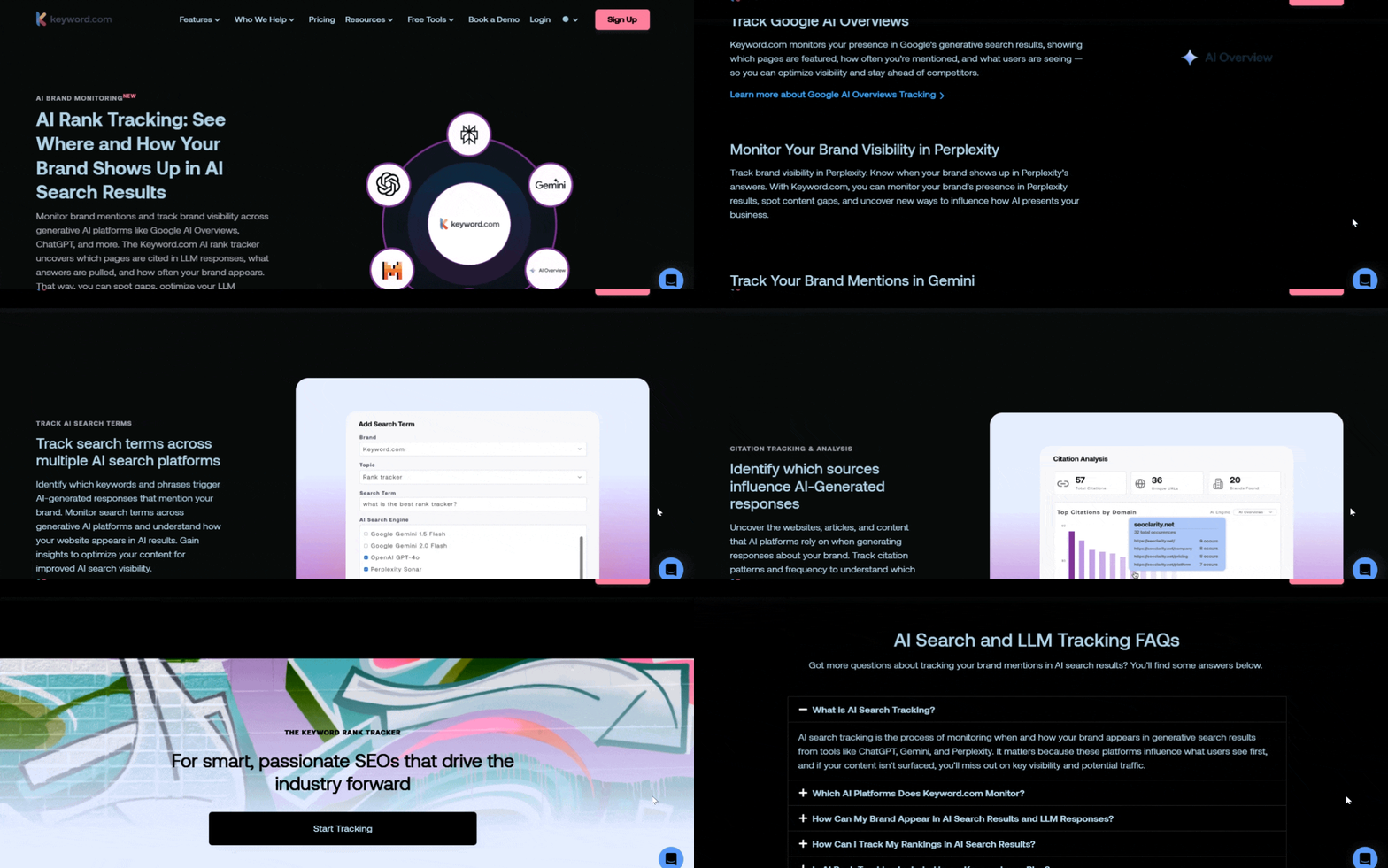
Another awesome example of multimodal content is this one by Superside.

It uses a well-organized blend of video explainers, graphic models, branded visuals and podcast clips to deliver layered insights. That’s the type of content AI systems love to reference!
Quick tip: use schema markup (VideoObject, ImageObject, HowTo) and descriptive alt text so AI crawlers can “understand” what your visuals convey and not skip over them.
3. Satisfy and Map Content to Nuanced, Contextual Intents
“Keyword research is absolutely not an equivalent to prompt research, because the intent buckets we used to work with are outdated,” says Josh Blyskal, AEO Strategy and Research Lead at Profound.
He shared insights from his research—37.5% of prompts on ChatGPT have a new intent: a generative intent.

Screenshot showing generative intent prompt on ChatGPT
Source
For example, ‘write a resignation email’, ‘create a 3-slide SEO proposal deck’. “Users arrive expecting the answer engine to create the asset, copy, code, image, plan, outline, whatever it is.”
This means, for AI search, there are layered intents beyond the traditional SEO intents (navigational, transactional, commercial, informational), that you know.
These do not invalidate the ‘old’ intents. However, to compete, you must move beyond basic keyword intent to understand the nuanced, underlying goals of a user’s queries.
The best way to do this is to optimize your content across a hidden range of fan-out queries and user contexts. Then, craft in-depth content that matches these broader, but related, intents.
What is a Query Fan Out?
“A query fan out is a technique used by AI systems, where an initial user query is expanded into a series of additional, related queries, known as synthetic queries,” says Mike King, Founder and CEO of iPullRank, in a recent webinar.
“Instead of just looking at the primary keyword, AI systems perform multiple searches in the background using these synthetic queries to gather a broader range of relevant passages and documents.”
Here’s a visualization of how it works out:

Query fan out flow chart showing related synthetic queries
Simply put, LLM-powered search engines look for more than exact-match keywords in content. They consider the primary and implicit contexts, as well as the user’s personalization.
Therefore, along with ranking for a specific keyword, you have to also rank for the fan out queries AI algorithms are using, to be discoverable on AI platforms.
You can use a query fan out simulator like Qforia to discover synthetic queries for Google AI Overviews and Google AI Mode, and this search query extractor for ChatGPT.
But, here’s a simple, DIY trick:
- Visit Gemini or Perplexity.
- Enter your query. For example, “how to start a local seo agency?”
- Click “Steps” (if you’re on Perplexity) or “Show thinking” (on Gemini).
- You’ll get a list of queries or long-tail keywords, plus sources the LLM used for its research.

Screenshot of Perplexity showing the ‘Steps’ feature for a query, listing fan out queries and sources
Now you have a list of queries, proceed to create content around them. However, don’t just treat them like regular keywords (i.e, exact-match input). Instead, weave them into your content naturally, like you’re anticipating what a curious user might ask next.
Mapping the Content
For the base query, “How to start a local SEO agency?” Your fan out might include:
- “How do I choose a niche?”
- “How much should I charge clients?”
- “Which tools do I need?”
- “What’s the best pricing model for new agencies?”
- “How do I land my first clients?”
- “What legal requirements should I consider?”
LLMs try to map this entire spectrum, so should your content.
Here’s how to make this work at scale:
- Structure your content around conversational subtopics. They don’t have to be exact-match phrases. Just clear, relevant headers that map to what users (and LLMs) are likely to ask. AI search platforms reward content that reads like a back-and-forth, with each paragraph answering a core question, and naturally teeing up the next.
- Include an FAQ section if needed, but only if the questions feel natural and insightful.
- Speak to context, not just the keyword. A section that breaks down agency models, for example, becomes more valuable if you also touch on pros/cons, use cases, and decision factors.
With this approach, LLMs are more likely to cite your content as a source, because it “understands” the full spectrum of the query, including its layers, follow-ups, and edge cases.
4. Fix Your Technical SEO
While we’ve covered a lot, initial discoverability by AI and LLM search systems is still a crucial first step to AI search optimization. You need to get the basics of technical SEO right, so AI can get to the good stuff—your content.
Some actionable things to do:

Technical SEO checklist for AI search optimization
Ensure AI Can Crawl and “Index” Your Site
If you’re blocking AI bots like GPTBot, PerplexityBot, or ClaudeBot in your robots.txt, your content won’t be seen. That means, they can’t cite, summarize, or include it in responses.
Start by checking which bots are allowed to access your pages and whitelisting the reputable ones. Here’s a list of AI bots you can allow (or disallow) according to tiptop, an SEO and marketing agency.

Source

Screenshot of AI bots to allow or disallow
That said, Gemini and AppleBot aside, many major AI crawlers can’t render JavaScript, yet. To show up in AI or LLM-search systems, your JavaScript must appear in plain text (HTML source) of the page. A tool like Prerender.io can help you generate an indexed version of your page so AI bots can see, crawl and understand the information.
Boost Site Speed and Core Web Vitals
Page Speed and Core Web Vitals are Google’s user experience metrics, but they also influence whether a site becomes visible on AI and LLM-powered search systems.
AI uses loading time as a quality signal. Thus, it prioritizes fast sites over slow sites, as they assume that faster content will provide a better user experience. Besides, AI crawlers have time budgets, so they’ll abandon slow-loading pages.
To avoid this, you should:
- Lazy load below-the-fold content.
- Compress images (typically WebP or AVIF format)
- Use browser caching and CDNs to speed up loading.
- Track your Core Web Vitals with PageSpeed Insights and Search Console.
Go Mobile-First
If your site isn’t fully responsive, AI may skip it, especially since mobile-friendliness is baked into their evaluation process. Make sure content is seamless across devices.
Serve Clean HTML and Semantic Tags
Use proper <article>, <section>, headings, alt text, and link descriptions. AI can’t interpret a wall of unstructured code. But it can when it’s well-organized and tagged.
Deploy Structured Data (Schema.org)
Structured data, through schema markup, creates rich snippets that drive clicks and helps AI systems understand your content.
Traditionally, search engines rely on this structured data to categorize and rank content. However, it provides explicit instructions about what your page is about, making it easier for AI systems to parse and potentially cite your content in responses.
But note: Schema isn’t always necessary in generative AI results. Research by Molly Katz on 100 healthcare websites showed that sites with schema appeared in AI Overviews only slightly more often than sites without it (18.1% vs 16.2%).
That said, schema still enhances discoverability and interpretability, especially when paired with strong formatting and contextual clarity.
For SEO and LLM best practices, use JSON-LD to implement schema. It embeds structured data directly into your HTML without cluttering your visible content.
Essential schema types include:
- Article (for editorial content).
- FAQPage (for Q&A sections).
- VideoObject | ImageObject (for video and image content).
- HowTo (for step-by-step guides).
- Product (for e-commerce).
These give AI bots a clear roadmap of what’s inside your content, increasing your chances of being cited in AI responses.
5. Analyze and Adapt to Prompt Patterns
The most effective content is well written and shaped around how people think and ask questions. This starts with understanding real prompt patterns. However, you must understand the entire customer journey, since each stage generates different types of questions that translate into valuable AI optimization prompts.
Think of it as amateur prompt engineering for brands.
First, mine yours (or your client’s) support logs, chat transcripts, industry forum discussions on Reddit, Slack and Quora, or sales calls. This is called “conversational mining”, where you identify recurring questions people ask naturally, not just topic keywords.
Observe how these customers frame their problems, what constraints or requirements they mention, and the amount of detail they provide. These are your best proxies for real user prompts.
Next, plug those into AI tools like Gemini or Perplexity (following the steps we covered above on query fan out and mapping intent) to see how LLMs expand and interpret them. What sources do they cite? How do they structure answers?
You’ll begin spotting trends: certain phrasings, formats, or unexpected angle shifts.
Once you’ve gathered five to ten conversational prompts common to your audience, bake them into your content strategy. Use them as section headings, FAQs, examples or analogies, especially if the prompt implies a “show me how” or “explain this like I’m 5” type of tone.
Aim to make both the structure and tone conversational.
6. Iterate and Refine Based on Results
Once your content is live, test, observe, tweak, repeat.
Start by manually running prompts through your preferred choice of LLM.
Is your content being cited or summarized? If not, change something. Try different headlines, rework intros, or tighten up schema.
You can A/B test prompt-friendly elements too, like adding an FAQ block, updating metadata, or adjusting passage structure. Then rerun the prompt and watch for changes in AI output.
If you’re lucky enough to get user feedback (via chatbots, search snippets, or analytics), use it. The more you refine, the better the AI system will recognize and surface your content.
Measuring Success in AI Search Visibility
After you’ve done what’s necessary to gain visibility on Google’s AI and LLMs, how do you know it’s working? We’ve covered the different metrics that matter when tracking AI visibility in another post.
But, here are some success indicators when optimizing content for AI search:
Brand Mentions in AI-Generated Responses
Pay attention to when and how often your brand or content is being cited directly in AI responses.
Keyword.com’s AI Overviews and visibility tracker lets you monitor brand mentions and visibility across major AI platforms like ChatGPT, Google’s AI Overviews, Perplexity and Claude.
It also allows you to see what queries trigger these mentions, which pages were featured in LLM responses and the specific answers that were pulled from the content. These insights help you adjust your campaign and improve your chances of AI visibility across platforms.
Watch this quick explainer video on how to monitor your brand’s visibility with Keyword.com.
Is Your Brand in ChatGPT, Perplexity & Google AI? This AI Visibility Tracker Will Show You!
AI Share of Voice
This metric tells you how often your content or brand shows up in AI generative responses for a given topic, compared to competitors. The higher your share, the more topical authority you hold in that space, especially across query variations. Hence, leading to more traffic, higher quality leads, and more sales.
Zero-Click Visibility
Similarweb reports that pages with AI Overviews now have zero-click rates of 80%, compared to 60% without AI-generated answers.
That means, even if users don’t click through, being cited in AI Overviews, summarized in LLMs or appearing in featured snippets, counts as a win. This can still help to build brand awareness, signal EEAT, and retain mindshare for future engagements.
AI-Referred Traffic
Start segmenting and monitoring traffic that originates from AI features (via UTMs or custom event tracking). While it’s still early days for precise attribution, it helps you understand what content is driving interest post-AI exposure.
Tracking AI Search Prompts With Keyword.com
Visibility in AI search might not always bring you traffic in the conventional sense, but it can lead to influence, trust, and eventually, conversions.
To track how your content performs in AI search, use Keyword.com. Our AI brand monitoring tool shows when and where your brand appears in Google’s AI Overviews, ChatGPT, Perplexity and more, so you can double down on what’s working and adjust where you’re being left out.
Start measuring what and where it matters. Sign up to get started.